By Analyst Team · Updated 2026-08-11 · 14 min read
If you're tired of paying $120+ a month for cable channels you barely watch — or you've been fighting blackout restrictions to catch every live match — you've probably seen "IPTV box" appear in YouTube tutorials and cord-cutting threads. The short version: it's a compact set-top device that pulls television channels directly from your internet connection. For most people, that means access to thousands of international channels, premium live sports, and on-demand movies at a fraction of the cable bill.
But before you click buy on the first glossy box you find, there are a few things worth understanding. This complete guide covers what an IPTV box actually does, how it works step by step, how to set it up, why it beats (or loses to) a Fire Stick, where to buy one safely, and the honest downsides most promotional content conveniently ignores. Read this first — then decide.
Key Takeaway
A quality IPTV box cuts TV costs by up to 60%, outperforms the Fire Stick for live sports, and takes about 15 minutes to set up. Want a provider that checks every box? Compare top-rated IPTV plans here.
LIMITED TIME AVAILABILITY
Unlock Full IPTV Box Access
Unlock complete high-definition channels and priority access packs. Lock in your pricing today before plans return to standard regional rates.
What Is an IPTV Box? (And What It Isn't)
IPTV stands for Internet Protocol Television. Unlike traditional TV that relies on antenna frequencies, coaxial cable lines, or satellite dishes, IPTV delivers television content through the same internet connection you already use for browsing and streaming. An IPTV box is the hardware that decodes that internet TV signal and turns it into a crisp, navigable channel interface on your television screen.
In practical terms, it's a compact device roughly the size of a small router. You connect it to your TV via HDMI, link it to your home network through WiFi or Ethernet, and then install one or more IPTV player apps. Once you log in with your subscription credentials, you get a live TV guide, an electronic program guide (EPG), and a video-on-demand library — all organised on a single clean dashboard.
The featured image above shows a typical real-world setup: an IPTV box streaming a live 4K football match onto a large modern television. That's the standard experience today — not the grainy, buffering mess that gave early IPTV a bad name during the 2010s.
Ready to move past the research phase? Secure special promotional rates instantly before the window closes.
Activate Your IPTV Box Subscription Now →How Does an IPTV Box Work? Step by Step
The technology behind IPTV sounds complex, but the whole setup usually takes about 15 minutes. Here's exactly what happens once the box reaches your home:
- Connect the hardware. Plug the IPTV box into your TV using an HDMI cable, then attach the power supply. Most modern boxes include a compact remote with a full Android-style interface.
- Put the device online. Connect through WiFi using the on-screen keyboard, or simply plug an Ethernet cable into the back of the box. If you plan on watching 4K streams, a wired connection is strongly recommended to avoid buffering.
- Install an IPTV player app. Some boxes ship with a pre-installed player, but most let you install standard apps like TiviMate, IPTV Smarters Pro, or XC IPTV from the Play Store or by sideloading an APK file.
- Log in with your subscription details. Your IPTV provider will give you an M3U playlist URL or Xtream Codes login — portal URL, username, and password. Enter these into the player app once and the app remembers them.
- Refresh the EPG. The electronic program guide shows the schedule for every channel, just like a cable TV grid. One click refreshes it, and you'll instantly see which live events are airing across thousands of channels.
- Search, browse, and play. Everything is laid out in categories — sports, news, movies, kids, documentaries, international channels. Click a channel, and the stream connects within a few seconds.
There's no satellite alignment, no engineer appointment, and no dish bolted to your roof. If you can configure a WiFi router, you can absolutely set up an IPTV box.
Concrete Benefits That Actually Matter
The most obvious advantage is price. Most IPTV subscriptions range from $8 to $20 per month, and many providers offer pay-monthly plans with no contract. If your regional cable bill has crept past $100, the monthly savings alone are enough to justify the switch.
Beyond cost, IPTV boxes are a serious upgrade for live sports fans. Football (soccer), American football, basketball, boxing pay-per-view, cricket, Formula 1 — a quality provider carries every major league from multiple broadcast regions, often in multiple languages. That means you're no longer locked into what your local sports network chooses to show.
- 4K and HDR streams. A genuine 4K IPTV box with 4GB of RAM plays ultra-high-definition content flawlessly, with Dolby Digital audio support built in.
- Multi-room capability. Most providers allow you to use one subscription on several devices simultaneously. That means one IPTV box for multiple TVs is completely realistic.
- On-demand library. Thousands of movies, documentaries, and full series are included in the same plan. Most IPTV boxes also run Netflix, YouTube, and Spotify, so you don't need a separate streaming stick.
- Portability. Take the box to a holiday home, your office, or on travels. As long as there's an internet connection, you've got your full channel lineup.
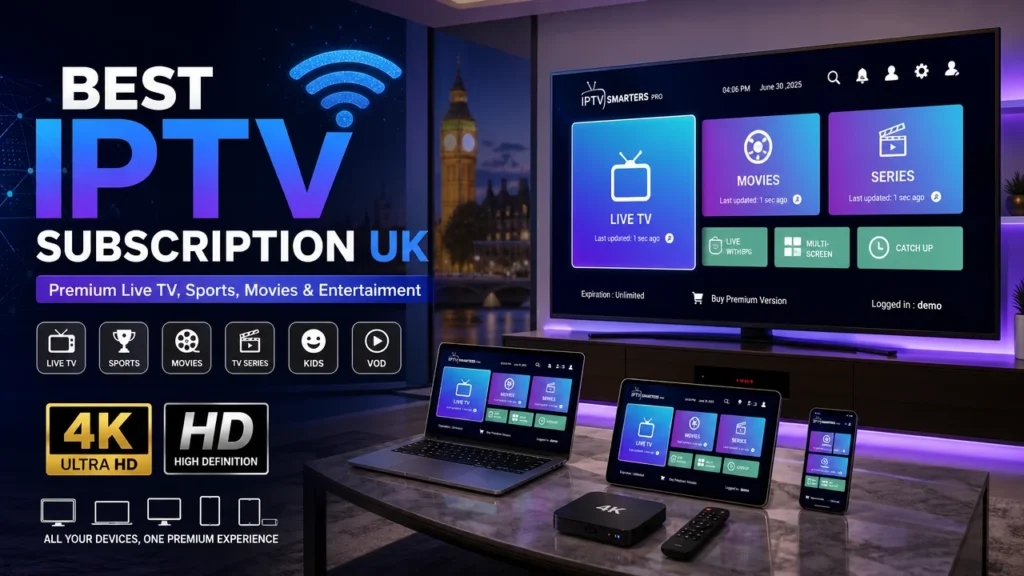
The image above shows what you can expect inside a well-configured IPTV player: a curated EPG with live sports at the top, clear 4K badges, and a responsive interface. This is the experience that turns casual cord-cutters into committed IPTV users.
The subscription side is where most people get stuck. Always use a free trial to verify channel selection, stream quality, and connection stability before paying for a full month.
Start with a free trial on the recommended provider →Honest Limitations You Should Know First
No device is perfect, and being straight about the downsides will save you from frustration later. Here are the real limitations of IPTV boxes:
- Your internet speed is everything. IPTV streams use serious bandwidth. A 4K live match can pull 25–50 Mbps by itself. If your broadband connection is unstable, the stream will buffer or drop entirely.
- Licensing gray areas exist. Some IPTV providers resell copyrighted content without proper broadcaster licensing. The technology is perfectly legal, but using an unlicensed service carries legal and security risks. Always choose a provider with transparent terms and reputable payment methods.
- Some technical comfort is required. This isn't plug-and-play like a Roku. You'll need to navigate settings menus, sideload an APK once in a while, and refresh the EPG after some channel changes. If that sounds intimidating, a mainstream streaming stick may suit you better.
- Bargain hardware is a trap. A cheap IPTV box with WiFi can work okay for standard-definition channels, but many budget boxes run outdated Android versions with weak processors — causing constant buffering and app crashes.
- A VPN is often advisable. In certain regions, ISPs throttle IPTV traffic or block access entirely. Running a VPN on the box or your router protects your privacy and keeps streams running smoothly.
Pros
- Saves 50–80% compared to cable
- Huge international channel lineup
- Best-in-class live sports availability
- 4K HDR support on quality hardware
- No long-term contract needed
- One subscription powers multiple TVs
Cons
- Requires stable, fast internet
- Unlicensed providers carry risk
- Setup takes some technical skill
- Cheap hardware underperforms
- VPN recommended in some regions
- EPG setup can need manual fine-tuning
IPTV Box vs. Fire Stick vs. Smart TV vs. Cable
The easiest way to understand whether an IPTV box is worth it is to compare it side by side with the alternatives you're likely considering. Here's the honest breakdown:
| Feature | IPTV Box | Fire Stick | Smart TV | Cable/Satellite |
|---|---|---|---|---|
| Monthly Cost | $8–$20 | $0 + app subs | $0 + app subs | $80–$140 |
| Live Sports Quality | Excellent (4K) | Good (720p/1080p) | Good | Excellent (720p/1080p) |
| Channel Variety | 5,000–20,000+ | App-dependent | App-dependent | 200–400 |
| Contract Required | No | No | No | Often 12–24 months |
| Setup Difficulty | Moderate | Very easy | Very easy | Professional installed |
| Multi-Room Support | Yes (1 subscription) | Per-device apps | Limited | Expensive extra boxes |
| 4K Support | Yes (native) | Limited apps | Model dependent | Limited |
The verdict: if IPTV is your main reason for cutting the cord, a dedicated IPTV box is the strongest option. If you only need mainstream apps, the Fire Stick is simpler. Cable only wins on pure stability — and you pay a heavy premium for that.
Who Is an IPTV Box Actually For?
IPTV boxes aren't for everyone, but a lot of households fit the profile. You're probably a great match if any of these describe you:
- Cord-cutters: You dropped cable but miss live TV. IPTV gives you all the live channels back at a fraction of the price.
- Sports fans: Live matches, pay-per-view events, multiple leagues in multiple languages — without local blackout frustrations.
- Expat communities: Living outside your home country? A solid IPTV subscription gives you home-country channels anywhere with internet access.
- Families with several TVs: One subscription can cover multiple box units around the house. No need for a second cable box at another monthly fee.
- RV owners and frequent movers: As long as there's WiFi, the box works. No transfer calls to a satellite provider, no rebooking engineers.
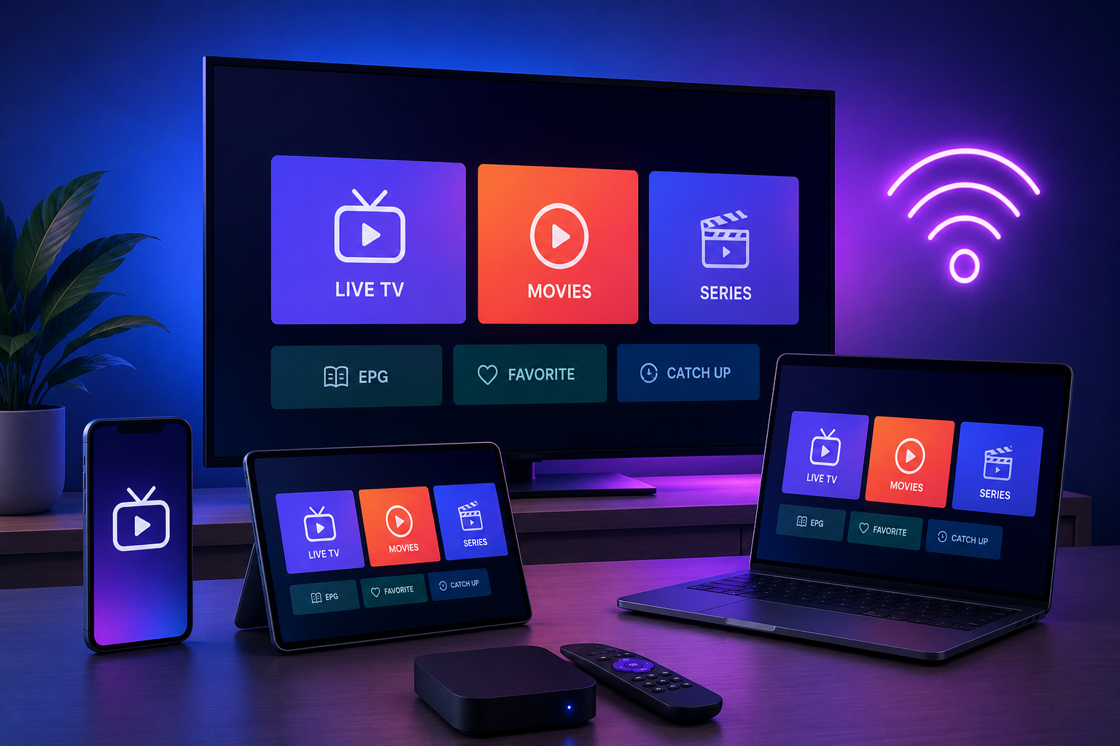
The hardware in the image above is all you need: a small streaming unit, an HDMI cable, and the remote. That's the entire physical installation — the rest happens on screen through the setup process outlined next.
How to Get Started With an IPTV Box
Ready to make the switch? Follow these practical numbered steps to go from zero to fully set up without the trial-and-error:
- Define your channel requirements. Which sports do you watch? Which countries' channels do you need? Movies, news, kids' content? Write down your top 10 must-have channels before you choose a provider.
- Choose the right box hardware. Look for a minimum of 2GB RAM (4GB recommended), Android 10 or newer, 4K output with HDR10, and dual-band WiFi. An Ethernet port is a big plus for stable 4K streaming.
- Pick a trustworthy provider. Avoid random marketplace sellers. Look for transparent pricing, customer support, and providers that offer a free 24-hour trial. Test the stream quality before paying for a full month.
- Install a quality IPTV player. TiviMate, IPTV Smarters Pro, and XC IPTV are the most reliable. Make sure the player supports Xtream Codes login, EPG, and video-on-demand categories.
- Set up the device. Connect the box to your TV, connect to the internet, install your chosen player, and enter your subscription details.
- Configure the EPG and favourites. Set the correct timezone so the program guide shows accurate schedules. Mark your most-watched sports and family channels so they appear at the top of the list.
- Enable a VPN if needed. If your ISP is known for throttling high-bandwidth streams, set up a VPN directly on the box or through your router.
- Run a full test before committing. Try live sports at peak evening hours, check the video-on-demand library, and refresh the EPG every day for the first week. A good provider will remain smooth throughout.
Final Subscription Window:
Activate Today →Affiliate Disclosure: Clicking this secure link verified by our network supports our team through standard partnership terms at zero extra cost to your invoice.
Final Verdict: Should You Buy an IPTV Box?
An IPTV box remains one of the smartest upgrades for anyone who wants real live television without the cable bill attached. The combination of 4K sports coverage, thousands of channels, on-demand content, and month-to-month flexibility is hard to beat — and for the right household, it completely replaces cable.
The two crucial decisions are the hardware and the provider. Buy a box with enough RAM and current Android software, and pair it with a provider that offers a trial, stable streams, and the exact channels you actually watch. Doing that homework cuts out 90% of the frustrations people blame on IPTV.
If you're looking for a recommendation, our team has tested and rated a number of IPTV providers for uptime, stream speed, and channel diversity. The button below connects you to the current top-rated subscription we're confident recommending for most households.
Frequently Asked Questions
What is the best IPTV box for live sports?
For live sports, hardware with at least 4GB of RAM, 64GB of storage, Android 11 or later, and a wired Ethernet port is ideal — wired connections dramatically reduce buffering during 4K matches. The subscription matters just as much: choose a provider that carries your preferred leagues in multiple languages and offers a free trial. The W32 model reviewed in this guide is currently our top pick for sports-heavy households. Pair it with a provider that supports multi-device connections so you can switch rooms without extra cost.
How do I set up an IPTV box at home?
Plug the device into your TV via HDMI, power it on, and connect it to your WiFi using the on-screen instructions. Next, install an IPTV player app such as TiviMate or IPTV Smarters, then enter the M3U playlist URL or Xtream Codes provided by your subscription. Refresh the EPG to load the full channel guide, and you're done within 15–20 minutes. The step-by-step setup section above walks through each stage in more detail.
IPTV box vs Fire Stick — which is the better buy?
The Fire Stick is better for mainstream apps like Netflix, Prime Video, Disney+, and Plex — the ecosystem is polished and the interface is simple. IPTV boxes are stronger for actual IPTV subscriptions because they're designed around channel lists, EPG navigation, and high-bitrate live streams. They also aren't restricted by Amazon's app approval policies. If your primary goal is watching live TV and sports, a dedicated IPTV box wins. If you're mostly streaming mainstream apps, the Fire Stick is sufficient.
Where can I safely buy an IPTV box?
Two types of sellers operate in this market: hardware retailers selling the physical device, and IPTV subscription providers offering boxes bundled with a plan. The safest route is to buy the box separately from a reputable tech store, then choose your subscription from a provider with transparent pricing and PayPal or card payment options. Avoid sellers that only accept cryptocurrency and give no post-sale support. A legitimate provider will offer a trial period and responsive customer service.
Is there an IPTV box subscription with no contract?
Yes — most IPTV providers operate on a month-to-month basis with no long-term commitment. Some offer discounts for quarterly or annual prepayment, but the flexibility of a rolling monthly plan means you can cancel whenever you want. Many providers also include a free 24-hour trial, which is the safest way to test performance before spending money. Look for providers that explicitly mention "no contract" or "pay monthly" on their pricing page.
Are 4K IPTV boxes worth the upgrade?
If your TV supports 4K and you regularly watch live sports or premium movies, then yes — the sharpness and colour depth are genuinely noticeable. A good 4K IPTV box also has faster processors and better memory management, which reduces buffering even on non-4K channels. On an older 1080p television, you can save money with a cheaper model and lose very little. For most new TV owners, though, a 4K box is absolutely the recommended choice.
Can I use one IPTV box for multiple TVs?
A single box can only output to one display at a time, but one IPTV subscription can be used across multiple boxes and devices in the same home. Most providers allow between two and five simultaneous connections depending on your plan. Practically, that means buying an IPTV box for each TV and logging into the same subscription on all of them. This is a far cheaper approach than paying for multi-room cable boxes.
Are cheap IPTV boxes with WiFi reliable?
Some are, but many budget boxes pack low RAM and older WiFi chips that choke on 4K streams. A reliable budget setup should have at least 2GB of RAM, Android 10 or newer, and 5GHz WiFi support. If your router is in a different room, spend a little extra for a box with an Ethernet port and run a wired cable for the most stable connection. The W32 model we featured is a solid budget option that holds up well in real-world testing.