By Analyst Team · Updated 2026-08-10 · 13 min read
Television used to arrive through an antenna, a cable box, or a satellite dish. Today, the internet does that job just as well — often better. IPTV, short for Internet Protocol Television, is the technology behind this shift. If you have ever typed "how does IPTV work" into a search engine, the direct answer is this: it sends live TV channels and on-demand video over the same internet connection that powers your Wi-Fi. Rather than broadcasting every channel at once, IPTV delivers the specific stream you choose, at the moment you choose it.
That one change — from broadcast to stream — explains why you can watch a Premier League match on a Firestick, catch up on last night's series in 4K, or take your entire channel lineup on holiday with you. The image below shows the everyday reality of this technology: a smart TV streaming a live match while a phone plays the exact same feed. This guide walks through the technology step by step, separates facts from hype on legality and safety, and shows you exactly how to set IPTV up on your own screens.
Want to skip the technical details? Here is the highest-rated IPTV provider we tested in 2026.
View Today's Special IPTV Offer →LIMITED TIME AVAILABILITY
Unlock Full how does iptv work Access
Unlock complete high-definition information and priority access packs. Lock in your pricing model today before plans return to standard regional metrics.
What Is IPTV? The Simple Definition
IPTV stands for Internet Protocol Television. The phrase describes any television service delivered over an IP network — in plain English, your home broadband or mobile data connection — instead of traditional terrestrial, satellite, or cable broadcast systems. The big difference is in the delivery model. A cable operator pushes every channel to your sofa at once and your box filters out the one you want. IPTV sends only the stream you selected, in packed internet data, like every other piece of traffic you receive online.
Most IPTV subscriptions combine three different formats under one login:
- Live TV — channels like ESPN, CNN, and Eurosport broadcast in real time.
- Video on Demand (VOD) — movies and box sets you can start, pause, or resume whenever you want.
- Time-Shifted TV — catch-up windows that let you watch a program after it aired.
When you open an IPTV app on a smart TV, phone, or set-top box, these three formats are usually blended into one familiar guide. That guide is why IPTV feels so similar to cable — until you realize you have a thousand more channels and a library of films built in.
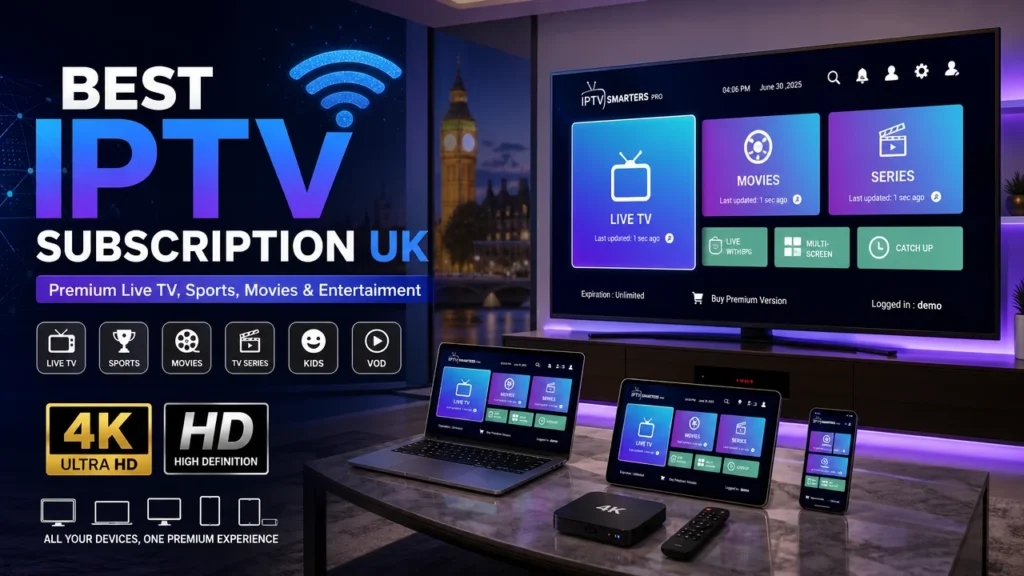
This is what a modern IPTV service actually looks like once it is running: a clean electronic program guide, organized sports categories, and a 4K movie vault living in the same app. The dashboard above shows that layout — you pick a channel or a film, the service streams it almost instantly, and the guide updates in real time.
Secure special promotional rates instantly before the window closes.
Activate Your how does iptv work Subscription Now →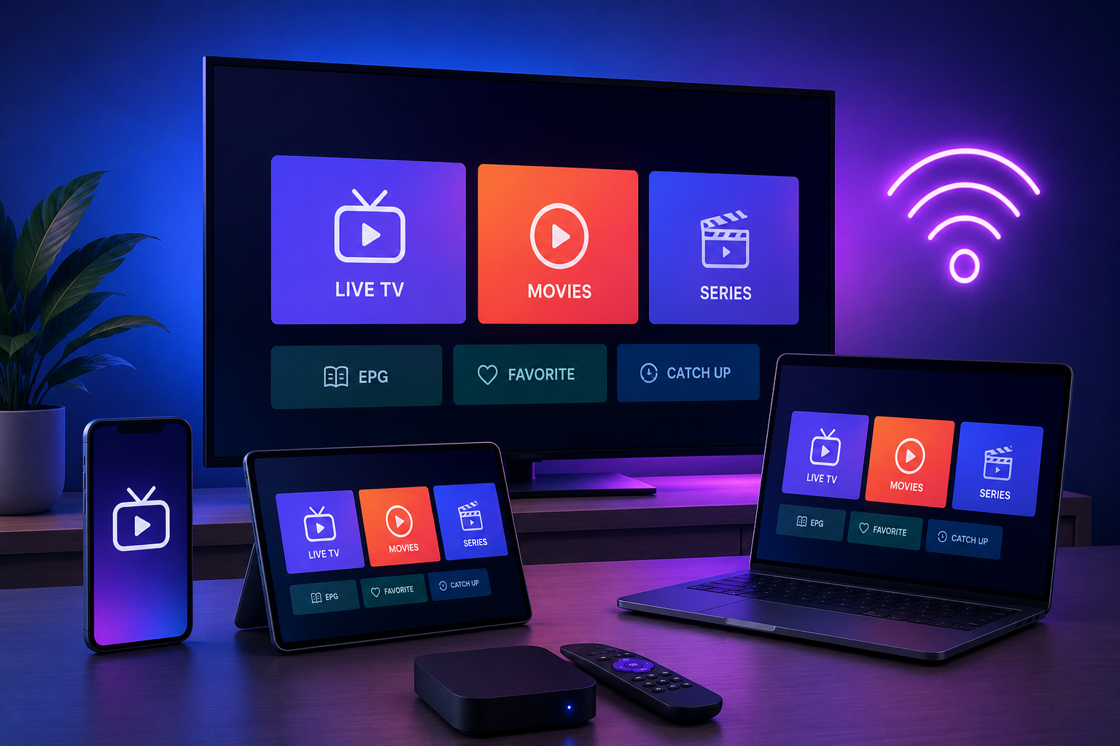
The diagram above strips away the marketing and shows the real path your video travels — from the broadcaster's camera to the streaming server to your living room screen. It is the same journey every website request makes, adapted for live television. Let's break down each step so you know exactly what happens when you press play.
How Does IPTV Work? Step by Step
Step 1: Content Acquisition
Every provider starts with a content source. Network owners like ESPN, the Premier League, or local broadcasters supply TV signals, films, and series. The provider either holds broadcast rights or aggregates licensed feeds, then prepares them for distribution. This step determines the channel list you will eventually see in your app.
Step 2: Encoding and Transcoding
Raw video is enormous, so it must be compressed before transmission. Encoders convert the feed into modern digital formats like H.264 or H.265, and transcoders create multiple quality levels — 480p, 720p, 1080p, and 4K — with matching bitrates. That is what lets IPTV adapt to your internet speed in real time: when your connection dips, the stream slides down a quality tier instead of cutting out.
Step 3: Delivery Through CDN Servers
The compressed files are stored on servers and pushed to a content delivery network (CDN). A CDN caches the same channels in multiple data centers around the world, so you always fetch data from the closest available server. This architecture keeps latency low and video quality high — the same system Netflix and YouTube rely on for their global libraries.
Step 4: Your Login and Channel Request
When you open an IPTV app and enter an M3U playlist or Xtream Codes credentials, the app builds its own channel list from the provider's middleware. Selecting a channel sends a unicast request to your nearest server, which responds with an active video stream. Because only the selected channel travels the network, switching between 1,000 channels can feel faster than flipping through cable.
Step 5: Buffering and Playback
Your device receives the stream as data packets, stores one to three seconds in a buffer, and begins decoding while the rest continues to arrive. The electronic program guide updates automatically, and subtitles or alternate audio tracks load on demand. You rarely notice any of this because the whole pipeline completes in under a few seconds.
The Concrete Benefits of IPTV for Real Users
IPTV's real-world benefits are easy to see once you have used it for a week. Most people switch for one of these reasons:
- Much lower monthly cost — IPTV subscriptions typically land between $10 and $25 per month, compared with $60 to $120 for cable or satellite.
- Huge channel selection — many services include 10,000+ channels covering sports, news, film, kids, and international networks.
- Device flexibility — one subscription works on smart TVs, Firesticks, phones, tablets, PCs, and set-top boxes.
- Built-in VOD library — movies and series are bundled rather than sold as a separate streaming app.
- Catch-up TV and cloud DVR — never miss a live show again.
- Instant activation — no engineer visit, no dish installation, no annual contract.
Honest Limitations You Need to Know Before Buying
IPTV is excellent, but it is not magic. Understanding the real downsides before you pay will save you from frustration.
- Internet quality matters. You need around 25 Mbps for reliable HD streaming and 50+ Mbps for 4K. Latency and jitter also affect live sports.
- Buffering can happen. Wi-Fi interference, congested provider servers, and peak evening hours all cause pauses.
- Legal gray zones exist. Unlicensed providers are common, so choosing a service takes research.
- Provider reliability varies. Some services oversell their servers or disappear outright.
- Support is usually remote. Most providers help via WhatsApp or email rather than a phone call center.
The Legal Side: Is IPTV Legal in the US?
IPTV is a delivery method, not a crime. Licensed IPTV services behave exactly like conventional broadcasters. However, some unlicensed services resell premium channels without permission, which violates copyright law. In the US, enforcement has targeted sellers rather than end-users, but using an unlicensed provider can still leave you with a dead service when the supplier gets shut down. That is why checks like trials, payment reviews, and transparent support matter.
IPTV vs Cable vs Satellite vs Streaming: Which Is Better?
The table below compares IPTV with the main alternatives so you can see exactly where it shines and where it falls short.
| Feature | IPTV | Cable | Satellite | Streaming Apps |
|---|---|---|---|---|
| Delivery method | Internet streaming | Coaxial cable | Satellite dish | Internet streaming |
| Live TV channels | 10,000+ typical | 100–300 | 200–400 | Few live options |
| Live sports quality | Excellent (60 fps) | Good | Good | Varies by app |
| On-demand library | Included | Limited | Limited | Strong |
| Monthly cost | $10–$25 | $60–$120+ | $60–$100+ | $6–$20 per app |
| Contract length | Month-to-month | 12–24 months | 12–24 months | Month-to-month |
| Needs internet? | Yes | No | No | Yes |
In short, IPTV offers the closest thing to cable TV over broadband. If you have a solid internet connection, it almost always wins on price and flexibility. If your internet is weak, cable or satellite remains the more dependable choice.
Pros and Cons at a Glance
Pros
- Lower cost than cable and satellite
- Massive channel selection
- Works on any screen with an internet connection
- Everywhere live-TV streaming for global sports
- Built-in VOD and catch-up features
Cons
- Requires stable high-speed internet
- Possible buffering during peak hours
- Legal gray areas with unauthorized providers
- Provider quality varies widely
- No local phone support at most services
Who Is IPTV Best For? Real User Profiles
- The sports fan — international leagues, 60 fps football, multi-view, and affordable sports packages make IPTV the best iptv service for live sports fans.
- The cord cutter — replacing a three-digit cable bill with a $15 monthly subscription is the number one reason people switch.
- The expat — home-country channels from thousands of miles away, without installing a foreign satellite dish.
- The family household — one login for every TV, phone, and tablet, removing the need for multiple cable boxes.
- The traveler — regular IPTV over hotel or rental Wi-Fi keeps your lineup with you anywhere.
How to Set Up IPTV: Practical Steps
Once you have a subscription, setup takes between five and twenty minutes depending on your device. Here is the exact process for most users:
- Check your internet speed. Run a quick speed test; aim for at least 50 Mbps if you plan to watch 4K or live sports on multiple screens.
- Choose a trusted provider. Verified comparison lists like buyiptv3.com remove most of the guesswork and help you avoid reseller scams.
- Pick your device. Firestick, Android box, smart TV, phone, or PC all work; pick the one you watch most.
- Install an IPTV player. Popular apps include TiviMate, IPTV Smarters Pro, and IBO Player. The provider may also ship its own app.
- Enter your subscription details. This is usually an M3U playlist URL or Xtream Codes username, password, and server URL.
- Set up the EPG guide. Attach the provider's electronic program guide URL so channels show titles, start times, and descriptions.
- Test everything. Open a live sports channel, check a 4K movie, try catch-up, and confirm the EPG is accurate before extending the plan.
Final Subscription Window:
Main Offer Today →Affiliate Disclosure: Clicking this secure link verified by our network supports our team through standard partnership terms at zero extra cost to your invoice.
Frequently Asked Questions
Final Verdict: Is IPTV Worth Your Money?
IPTV is not a hack or a shady workaround — it is simply television delivered over the internet, the same way music shifted to Spotify and radio shifted to podcasts. The technology has matured to the point where a single subscription can replace cable, satellite, and several streaming apps at once. If you have a stable internet connection, the benefits of live sports packages, catch-up TV, and multi-device streaming are hard to ignore.
The real variable is the provider. A reliable service delivers sharp video, honest channel lists, and responsive support. A cheap, unverified seller creates endless buffering and disappears at renewal time. Start with a short plan, test the sports channels during a live event, and check the EPG quality before extending. That practical approach will save you from the disappointment that fuels so many negative reviews.
If you want a shortcut to the shortlist, the curated provider guide at buyiptv3.com has already done the reliability testing for you. It is the same list our team uses when recommending a first IPTV subscription in 2026.